A Babylon 5 Retrospective: The Magic of the 24-Episode Season
Revisiting J. Michael Straczynski's sci-fi masterpiece decades later. Why the lost art of the 'filler' episode and passionate acting created a universe we'll never see again.

I discovered Babylon 5 for the first time on a road trip with my dad.
It was, objectively speaking, a pretty terrible road trip. The car we had been driving (purchased from a family "friend" who knowingly sold us a dud) had its transmission completely blow out. Yet, something amazing came out of being trapped in the middle of the Nevada desert for close to a week. While my dad and I stayed in a funky little hotel room waiting for my mom to come rescue us in my godfather's car, we discovered a space station in neutral territory.
 Odin Halvorson
This was the era of the TV Guide, where the media you consumed didn't come with the ability to pick and choose on demand. Someone else decided what you got to watch and when. But Babylon 5 was having its moment. I was likely watching one of the later seasons on air, or perhaps a syndicated rerun, but I remember being utterly enthralled. I had already watched a little bit of Star Trek: The Next Generation, but Babylon 5 captured my imagination in a completely different, vibrant, and vital way.
Now, as I approach my thirty-fifth year of existence, I am returning once more to a series that I have rewatched consistently every two to four years of my life.
I am struck by the humor and the incredibly potent moments of connection
The Evolution of a Sci-Fi Masterpiece
Starting with Season One, skipping the pilot this time and jumping straight into the first syndicated episode, I am instantly struck by how much the show evolved over the course of its history.
The first couple of episodes have that delightful, low-budget feeling to them. There are distinct artifacts of growth: moments of blocking and character work that feel a little bit like a stage play still going through dress rehearsal.
But I am just as struck by the humor, and the incredibly potent moments of connection.
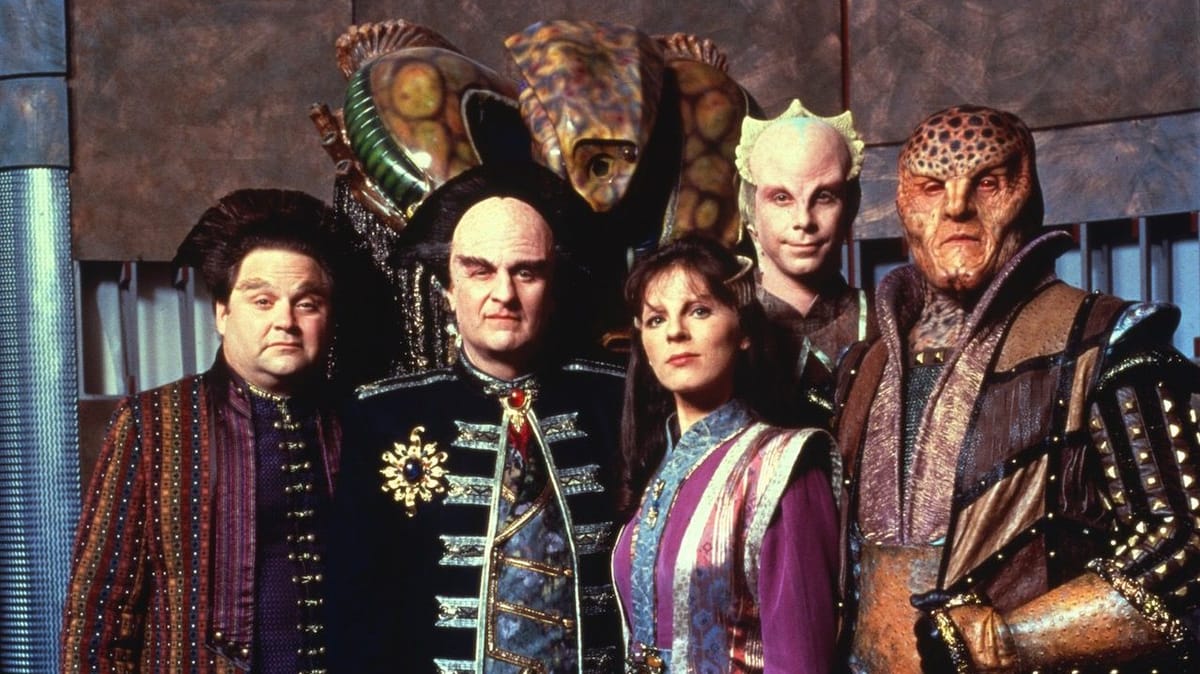
Michael O'Hare is an incredible actor who simply exudes presence on screen. Meanwhile, Andreas Katsulas manages to project more depth of emotion into G'Kar (a character hidden behind roughly five hundred pounds of prosthetic makeup and paint) than many actors manage with their bare faces in the center spotlight.
The Core of Great TV: Purpose and Passion
Rewatching this show is a stark reminder of what is most important when it comes to good television. It’s not the special effects. It’s not the sets. The writing is definitely vital, but truly fundamental is the cast of actors assembled to do the work, their passion for it, and their deep connection to the material.
John Osborne Hughes, on his excellent podcast The Spiritual Psychology of Acting, asks a vital question about an actor's purpose: Do they have the purpose to help? Does a cast of actors have the purpose to turn a low-budget syndicated television series into something great?
That sort of passion is what makes an actor shine. You can see their commitment. You can tell they believe in what they're doing and are having fun with it. Creator J. Michael Straczynski gave them the room to do exactly that, delivering incredible scripts week after week that allowed individual, grounded personalities to shine through.
We ended up with an era of modern TV series that are often visually spectacular but narratively inferior
Atmosphere: Music and Visceral Physics
I am also continually struck by the music of Babylon 5. The composition (a mixture of excellent orchestral scoring alongside more modern, synthesized musical techniques) created a really powerful thematic opener. (This, incidentally, was one of the failings of Babylon 5’s short-lived sequel series, Crusade). Good music is a potent force within any cinematic experience, and B5 did a phenomenal job bringing an epic musical overtone to bear.
Furthermore, while the show certainly carries the vestments of '90s low-budget science fiction, what it did with that budget was honestly incredible. It managed to make bare-bones, modular sets come alive. By combining the mindset of NASA engineers with state-of-the-art (for the time) computer modeling, they created spaceships and environments that felt grounded in actual physics. The world felt visceral. You could almost reach into the screen and touch it.
In Defense of the "Filler" Episode
There is also a specific kind of magic that can only occur in this era of syndicated television, a magic I fear is entirely lost in the modern, tightly-packed storytelling mode of the streaming era.
Today, we have traded the 22-to-24-episode season for an 8-episode "dramatic arc." As television costs ballooned massively, we ended up with an era of modern TV series that are often visually spectacular but narratively inferior.
One of the most important aspects of science fiction and fantasy is the connection the characters have to one another (how they interrelate, interact, and simply exist within their world). In shows like Babylon 5, there are "filler" episodes. There are episodes where characters get a moment to shine on their own for no grand narrative purpose other than the fact that the actor had a contract.
I think that’s fabulous. Those "throwaway" episodes, written in a hurry or penned by a random guest writer just because the formula required it, can often be profound. They add little touches and details to the world and the characters that immerse you further into the universe.
I think about this a lot with modern shows like The Expanse. I quite liked it, and in some ways, it did a better job than the books in capturing an immediacy of plot. But in other ways, it failed dramatically to capture the subtlety of the original novels because its arcs were heavily compressed. The episodes were smooshed into tight little bunches. There wasn't any room to just breathe.
Over to You
I will always be nostalgic for the era of syndicated television, with its twenty-plus, 45-minute episodes. We will probably never get an era quite like that again, but at least we have Babylon 5. I can safely say I would not be the person I am today if it hadn't been for this show.
What about you? What are your favorite nostalgic shows? Do you still go back and rewatch them? What aspects of the TV and cinema you grew up with changed your life?
Let me know in the comments... I’d love to hear about the media that shaped you.
I’m Odin Halvorson, a librarian, life coach, and fiction author. If you like my work and want to support what we do here at Unenlightened Generalists, please consider becoming a paid subscriber to our newsletter for as little as $2.50 a month!
Support us in other ways:
- Start writing and reading with the Supernote, and support me at the same time!
- Like audiobooks? Hate DRM? Use this affiliate link to sign up for Libro.fm, where you actually own the books you buy!
- Want your own Ghost newsletter? Check out MagicPages for the cheapest hosting rates via my affiliate link (they even offer lifetime hosting plans!)
Thanks for your support!