The Averaging Machines
From Technocracy to Digital Sovereignty: A Communitarian Manifesto


I am not one for simplistic arguments of good and bad; the world is generally more complex than that. Technology, one may argue, is the total realization of human history—an amplification mechanism for our will to achieve and to build. These are not necessarily bad things in and of themselves.
However, the systems that surround technology, the systems that support technocracy—these are the enemy.
The Process of Evil
We are not looking for a single source of evil; we are looking for a process of evil. This is not the moralizing search for a devil, but rather finding the "devil in the details," the devil in the flow. This goes counter to the human urge to find an opposing force and work against it.
In library school, a main focal point for AI use was our primary job: helping people access knowledge, connecting them, and using technology to reduce barriers and create an egalitarian playing field. But as we move into the next century, the impacts of AI on the human condition and our ecological systems are where our goals must be centered.
"We need to think about what the process of control looks like in a world intermediated by AIs. This isn't just a matter of personal well-being, but a matter of the systemic survival of the species."
The Tool That Uses Us
Where I fall is often a privacy and security back-point. New technologies are sold as brilliant and exciting while opening the end user to potentially diabolical consequences. We must look at technology from a communitarian position, aligning its evolution with an ecological approach that recognizes:
- Sovereignty: The need for well-being within the natural systems we inhabit.
- Cooperative Control: Technology must be cooperatively owned to have any hope of moral validity or practical structuring.
We have to remember that technology is not a tool that we use so much as a tool that uses us. We are shaped by the tools we use, whether they be linguistic or chopsticks. Technology manufactures the reality in which we live, and its creation is heavily entangled with power and hierarchical modes of being. The more centralized our power systems become, the more dangerous to our well-being technology becomes.
The Age of the Averaging Machine
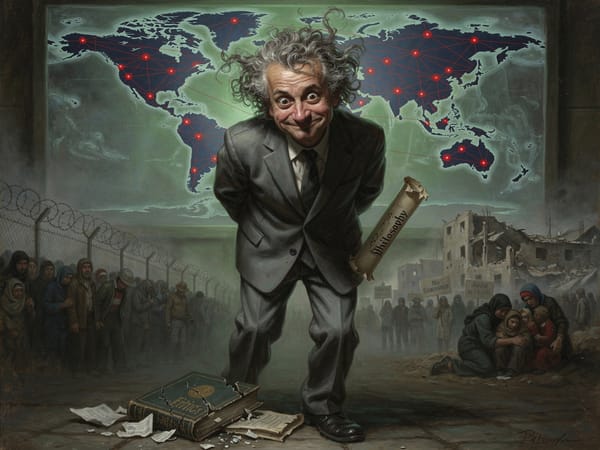
Artificial intelligence opens a dangerous doorway: a platform where the sum total of human knowledge can be accessed for an incredibly low intellectual cost. But we must consider that we ourselves are being used. In a Chomskyan or Baudrillardian sense, our reality is altering because the owners of this technology are dictating the norms of our entire society.
These owners are now able to define the most intimate aspects of the human experience:
- They say what is a friend.
- They define what is—and isn't—a mental health crisis.
- They determine who is a suicide risk and who is not.
- They define what the "average" use of language looks like.
They do this with absolutely no grounding in the unique circumstances, culture, or spiritual interconnections that make up an individual. We have created averaging machines that exist to foment an average society. But average according to whom?
The Cooperative Path Forward
I approach this issue as someone who wants technology to support the best that humans can be—to return agency to the individual and push back against entrenched, top-down power structures that privilege an uninspired few over the masses.
To this end, I envision cooperative technology organizations following in the footsteps of workers' co-ops like Mondragon or Enspiral. In these spaces:
- Technology is built by deeply invested and caring individuals.
- Decisions are made by the community, not a remote elite manager.
- The ultimate goal is a technology that fosters true community and digital sovereignty.
This is where I am placing my primary aims as a coach, a librarian, an academic, and an entrepreneur.
What about you? How do you envision shifts in our technology and our society? What would you do to turn this AI epoch into a positive state for both our ecology and our society?