The Last Jedi: A Belated Deconstruction of the 'Skywalker' Mythos
A deep dive into the brilliance and fundamental problems of Rian Johnson's The Last Jedi, viewed through the lens of Film Crit Hulk's 2017 critique.

Now, some people might argue that it's a little late to be responding to an article from 2017. I would argue that this is the perfect amount of space for me to finally comment on something I care about deeply: Star Wars.
Diving into the blog post by Film Crit Hulk, I was cast back into the memory of watching the film for the first time—the things that I liked about it, and the things that I really, really did not. It is the reason why, in the subsequent years, I have only gone back and watched that film once. Even while I think The Force Awakens and The Rise of Skywalker are two of the most bland and uninspired films in recent science fiction history—and think that technically The Last Jedi is far superior—I have absolutely zero interest in watching it again.
The Problem with the "Mystery Box"
I don't exactly classify myself as a super-fan; I love Star Wars and have a deep personal connection to it, but I don't usually obsess over the real-world minutia. However, when it comes to the storytelling, the writing... well, then I get punchy. Largely, my issues with the current trilogy can really be summed up in one name: J.J. Abrams. I have always disliked J.J.'s work, from Lost through Fringe, as well as his version of Star Trek. His work is shallow, even "facile" to be a little harsh.
Film Crit Hulk sums it up well, noting that there is never a larger context in Abrams' work. There is the promise of deep questions, but they don't lead anywhere because:
"That's the mystery box. That's literally the design. He doesn't think it matters what's inside as long as he makes you think it's important. He's literally said this. And that's what it's always been. It's a grift. A con".
The blogger argues that this "lack of point" is symbolized in the final moment of The Force Awakens, with Rey standing there to hand a lightsaber to Luke. They describe it not as a story beat, but as:
"Just someone waiting to hand a baton to someone who can figure out a way to have any of this make a lick of sense".
I both disagree and agree with that. It is a metatextual moment for the fans, and The Force Awakens suffered heavily by being too focused on a "nostalgia mode." Yet, as someone who grew up with these films, I felt a certain joy in that moment—the sense of a great artifact being passed to a new generation.
Irreverence vs. Consistency
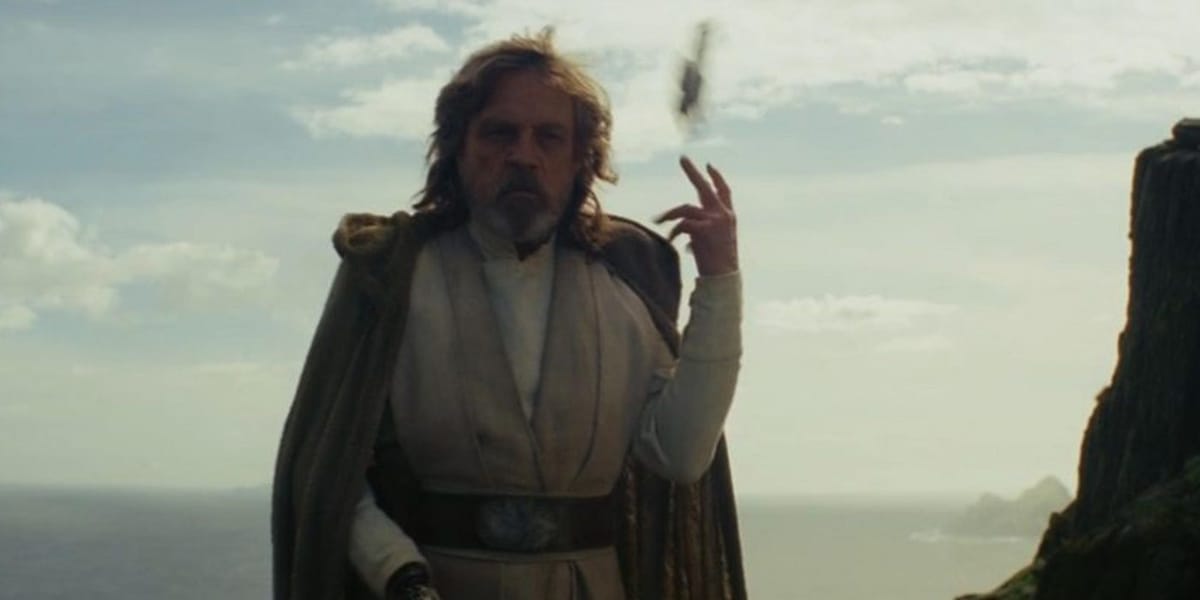
When Rian Johnson’s film opened and Luke simply threw the lightsaber off the cliff, I cracked up. I loved it. It was a beautiful moment of irreverence following so much fan service. It signaled that we weren't going to follow J.J.'s plot anymore; we were going to do something new.
In that, however, creates both the brilliance and the fundamental problem of The Last Jedi. The blogger states:
"...the point is actually that beyond the artifice, it is actually the pure story level that makes things meaningful and last".
I agree, but the problem is that Rian Johnson created a deconstructionist film with a tight internal storyline while giving absolutely no thought to the decades of work that went into the Star Wars canon. He gave no thought to internal consistencies beyond what he needed for a snappy scene. While J.J. creates mysteries with no answers, Johnson (at least in this film) creates beautiful cinematography without any sense of how it changes the larger story construct.
Take the "Holdo Maneuver," where a ship is cut in half at lightspeed. From a photography perspective, it was beautiful. From an in-world story perspective, it makes no sense and undoes the logic of every defensive technology in the franchise. The blogger highlights that everything in the film is "built on direct storytelling function," and that’s largely true, but it is only for Rian Johnson's limited story.
Lineage and Spirituality
I do like that Johnson’s focus shifted away from lineage—a point the blogger also calls out. We moved away from the idea of an all-powerful family controlling the fate of the galaxy. This moves us away from the "regal thinking" that only certain bloodlines matter. Johnson highlights what the blogger calls the "nameless young children who are put under the thumb of the world," showing that the Force belongs to them, too.
However, there were moments that truly bothered me. I really disliked the Admiral (Holdo) thanking God or praying to God. We’ve had very little sense of specific Earth-style religion in the original films. Bringing that in bothers me as an agnostic; I prefer my spirituality in a wider, decontextualized, metaphorical mode.
Conclusion? A Hollow Deconstruction
Ultimately, the film jumps through too many hoops. While Johnson does capture something meaningful in how he highlights the ills of high society and the villainy of capitalist war profiteering, Andor has since explored these issues in far better detail.
Johnson treated The Last Jedi like just another movie—and frankly, one that he doesn't seem to like that much—rather than treating the fans with the respect they deserved. He could have grounded the movie in the lineage of prior Star Wars books and comics that attempted to bring deeper questions to the fore. Instead, he created a work that tackled big, often metatextual, ideas without maintaining consistency with the landscape of the story he was treading upon. At the end of the day, it’s a film full of pretty scenes, but I just don't want to watch it.
I’m Odin Halvorson, a librarian, life coach, and fiction author. If you like my work and want to support what we do here at Unenlightened Generalists, please consider becoming a paid subscriber to our newsletter for as little as $2.50 a month!
Support us in other ways:
- Start writing and reading with the Supernote, and support me at the same time!
- Like audiobooks? Hate DRM? Use this affiliate link to sign up for Libro.fm, where you actually own the books you buy!
- Want your own Ghost newsletter? Check out MagicPages for the cheapest hosting rates via my affiliate link (they even offer lifetime hosting plans!)
Thanks for your support!