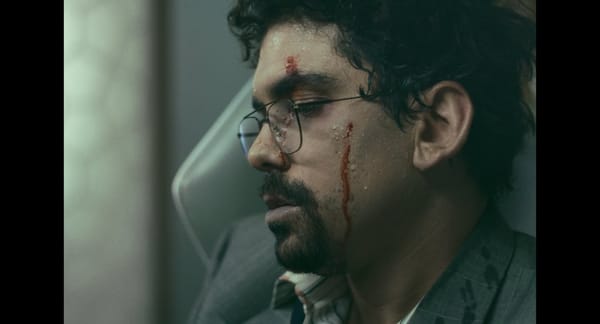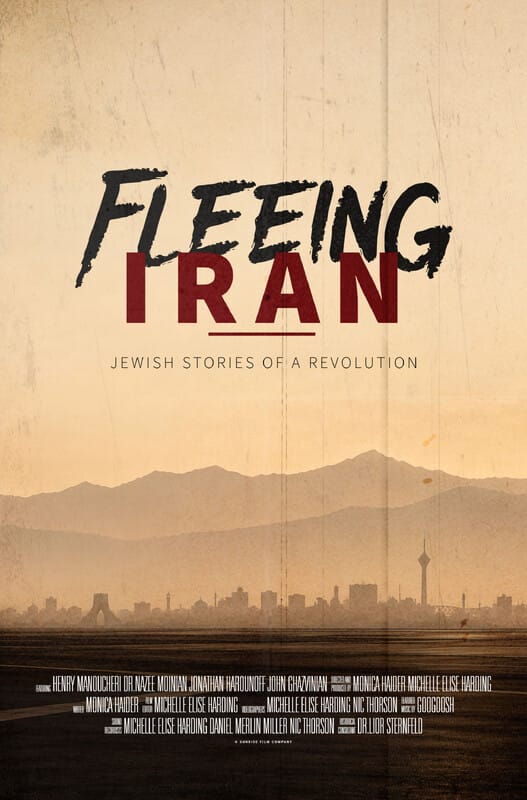
A revolution is coming, what do you take with you when you flee?
Dear reader, please consider becoming a paid subscriber today. The work we do at the Unenlightened Generalists is supported directly by you, our readers. Every week, we spend dozens of hours planning, researching, and writing material from YouTube videos to these very articles. This work is our joy and passion, but it's you that makes it possible.
For Nazee Moinian’s family, the answer was carpets and jewelry, money and a single Donny and Marie Osmond poster taken off her bedroom wall. The place was Tehran, in the last years of the Pahlavi era. The film Fleeing Iran knows that the poster is the sort of domestic image that’s worth a thousand words, but when it switches into its historical mode, it starts to lose its nerve.
At a glance, the stock footage of 1970s Tehran could be any American city of the same era. Modern buildings, Western clothes, families in ordinary rooms. This isn’t the Iran of the modern evening news, and that’s the point. The film wants you to see the country the witnesses lost. The footage does that work better than any narration.
But those images were also the Shah’s Iran, and the Shah’s Iran was built on a coup.
The country the witnesses remember was shaped by an earlier experiment: a fragile parliamentary opening after the Second World War. Iran had a raucous press and a parliament that could defy the monarch, and a labor movement with real footing in the oil fields and the schools. Mohammad Mossadegh, the prime minister, nationalized the oil industry in 1951. The Tudeh Party, Iran’s communists, had a real base in that public life, and the fear of them helped sell the coup in Washington. In 1953, the CIA and MI6 overthrew Mossadegh in order to protect British oil interests and restored the Shah. The coup set the terms for the next quarter-century: the secret police and the economic modernization that made a few people rich and left a lot of people angry. It also made the 1979 revolution possible. The revolution was the bill for a quarter-century of autocracy underwritten by Washington and London.
That’s the history the film left out. It mentions the Shah’s closeness to Washington and shows the demonstrations, the crowds, the portraits of Khomeini, but it never names Mossadegh or explains the coup. The result is a film about Jewish Iranians fleeing a revolution that seems to come from nowhere. The revolution came from a very specific place. The witnesses are fleeing the consequences of a political order that the West helped build.
The film’s personal stories are still the best thing in it. Henry Manoucheri remembers his father’s import business, the Phantom jets at Karaj, and an uncle who was imprisoned on a spying charge and ransomed while the family cried on the phone. Moinian remembers an Iranian identity that was “through and through,” with Jewishness as “a personal love affair and belief in God.” One witness says there is a sense of abandonment, “almost as if you’re an orphan.” The film lets those sentences sit. It lets us sit with the stories, grounded in objects and anchored by archival footage, so that in a mere fifteen minutes you feel that you suddenly know something intimate of this country.
The problem is that the film doesn’t trust the history enough to tell it. Fifteen minutes is not much time, and the film spends a lot of it on a compressed version of the Pahlavi era that skips the part that matters. The archival footage (Persepolis, the Shah on a state visit, the demonstrations) illustrates the narration without deepening it. The family photographs do more. The film is at its best in the apartments, with the witnesses and their objects, and at its weakest when it tries to summarize a century in a few lines.
It’s also narrower than its title. The witnesses who left are prosperous and connected. Their experience was hard in its own way, and it’s also steeped in a specific kind of privilege: carpets and jewels to carry, passports and tickets to get out. The Jews who stayed get one line, “very insular” and anonymous. Those communities still exist in Iran, and they are at risk from Israeli and U.S. bombing runs. The film mentions them and moves on. I kept waiting for it to turn back.
It never does.
Googoosh’s “Hamsafar” is the right song for the end, a traveling companion’s song for people who never stopped carrying the road with them. Near the end, Harounoff says the diaspora feels an innate connection to the land, and that many who were forced to leave would love to return one day. The film leaves us with that longing, leaves us with a sliver of insight into a life and history profoundly important to the political scene of the last century, and even more profoundly human in its investments.
The best thing about Fleeing Iran is that it made me want a lot more. As a potential teaser for a longer documentary, it did well; as a comprehensive telling of an important story and a deeply interesting Jewish culture, it managed to only just scratch a complex and fascinating surface. Watch it for the lives you get to glimpse, but then go find a deeper source to plumb for a fuller picture of Iran.
Fleeing Iran: Jewish Stories of a Revolution is currently on the festival circuit. Festival page. Runtime: 15 minutes. Directed by Monica Haider and Michelle Elise Harding; written by Monica Haider; sound design by Michelle Elise Harding; historical consultation by Dr. Lior Sternfeld; featuring Henry Manoucheri, Dr. Nazee Moinian, Jonathan Harounoff, and John Ghazvinian.
I’m Odin Halvorson, a librarian, life coach, and fiction author. If you like my work and want to support what we do here at Unenlightened Generalists, please consider becoming a paid subscriber to our newsletter for as little as $2.50 a month!
Support us in other ways:
- Start writing and reading with the Supernote, and support me at the same time!
- Like audiobooks? Hate DRM? Use this affiliate link to sign up for Libro.fm, where you actually own the books you buy!
- Want your own Ghost newsletter? Check out MagicPages for the cheapest hosting rates via my affiliate link (they even offer lifetime hosting plans!)
Thanks for your support!