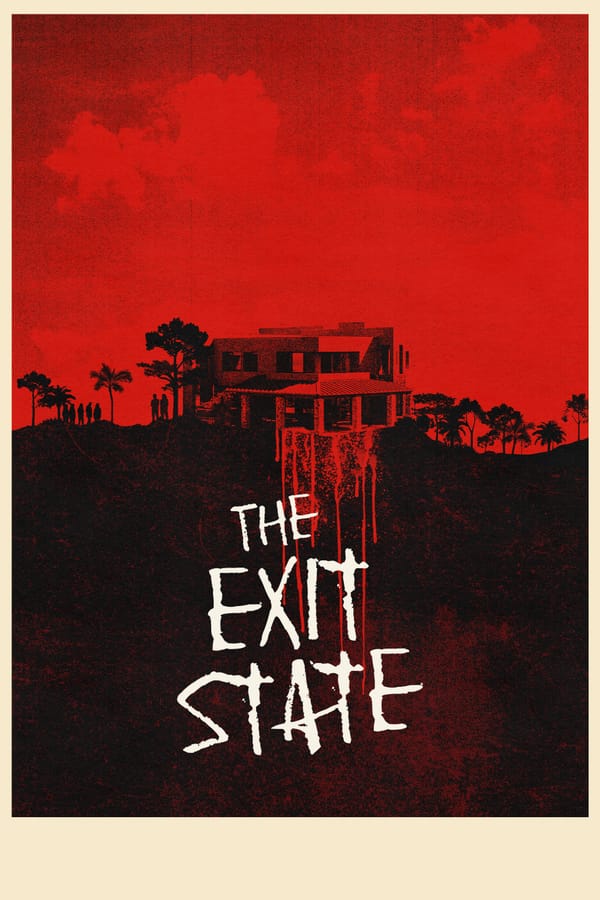
The trouble with The Exit State starts around the thirty-six-minute mark, when the film shows its hand. By then, we know who the killers are and why the house is a trap. The rest of the film is a long walk to the same conclusion. That is the central problem with Gabriela Ledesma’s film. It mistakes a premise for a plot.
Dear reader, please consider becoming a paid subscriber today. The work we do at the Unenlightened Generalists is supported directly by you, our readers. Every week, we spend dozens of hours planning, researching, and writing material from YouTube videos to these very articles. This work is our joy and passion, but it's you that makes it possible.
Don't get me wrong, though: the premise is a strong one. Zoey (Cindy Nguyen), a young journalist carrying sensitive footage of U.S. officials, joins a group of Americans fleeing a collapsing authoritarian state. They take shelter in a luxury house inside a "sovereign border zone", hosted by Vince (Josh George) and Claire (Callie Schuttera), a wealthy brother-and-sister duo. The house is gorgeous and the pool is inviting. But then the masks come off and a nightmare begins.
First, let me say unreservedly that the film looks and sounds good. Sam Wilkerson’s camera loves the house: the orange walls, the stone columns, the pool at night, the long shadows in the hallway. The close-ups are intimate and unsettling, and the sound design makes every blow land. The cast is also clearly committed. Josh George and Callie Schuttera give Vince and Claire exactly the right mix of charm and menace. Sharon Lawrence arrives late (with hardly three minutes of screen time) and yet she steals the film with a few lines. But the supporting cast is equally as strong, especially Cindy Nguyen as Zoey and Clayton Ferris as Andrew. Also, it would be remiss of me not to mention this incredible fact: The film was made for $150,000 in nine days, and yet it feels like it cost low millions at the least. Being able to do so much with so little is really an incredible feat. I jsut wish the screenplay had lived up to the rest of it.
The film wants to be a dark comedy of manners. It also wants to be a siege thriller and a political horror film in the vein of Get Out and Civil War. It never commits to any of them. The murder scenes are supposed to be darkly-comic, but the banter is not sharp enough to carry the film. The siblings’ relationship is meant to be the gravity that tugs the viewer along, and actors have the right chemistry for sure, but the script gives them cruelty without revelation, and the weirdness never accumulates into anything meaningful. Most of the time, it just feels like the writers wanted a shocking line, and meanwhile the siblings remain a blank. “I liked it better when we just poisoned everybody on night one” is meant to be shocking and funny. It lands as try-hard. The film keeps reaching for a killer’s comic timing, but it never finds the rhythm that would let the cruelty land as a joke; it settles for a pose.
The deeper problem is structural. Once the film reveals that the siblings are killers, it has no new information to withhold. The guests suspect, the siblings lie, someone wanders into the wrong room, someone dies. Repeat. The film mistakes the revelation of the operation for a plot. The characters have no plan and no clock, and nothing they learn changes the terms of the trap. Get Out works because the reveal changes the rules and gives the protagonist a new goal. The Exit State reveals the rules and then asks us to watch the same game play out with the inevitability of a car crash on the news.
Spoilers ahead for the final act.
The film’s political aspirations are stronger than its actual political examination. The group is fleeing a state that has suspended due process. The IBZ is a sovereign enclave carved out by wealthy families, and the hosts are a family business with a quota. The mother is the Agent running the whole operation and the border is a private jurisdiction backed by the state. That is the film’s central tenet: class war. Only, the premis never manifests itself beyond the metatextual. The film’s own tagline is a better thesis than most of the dialogue: “Escaping doesn’t make you part of the revolution.”
The filmmakers seem to see the horrific workings of the modern American state clearly. Ledesma has said the film is about complicity—“Oppressive systems aren’t sustained by cruelty alone. Often, indifference does just as much of the work.” But then the film goes on to keep this as a background note in a mishmash of violence and bleak humor. Where Civil War kept the politics in the country itself, The Exit State makes them a lecture overheard while walking past the classroom door. The film tells us the rich are complicit when it needs to show us the system in action in a way that surprises us.
The final scene, in which their mother, the Agent (Sharon Lawrence), congratulates Vince and Claire on being “almost at quota” and talks about the next groups almost like she's some sort of a regional chain manager, is chilling. “It’s kind of hot out here” is a perfect closing line: the flatness of evil, the weather report from hell. The next group is already on the calendar. But it never managed to make the first group of people stand out as anything but predestined murder victims, and so instead of feeling shock and dread, the viewer is more likely to walk away feeling sort of depressed.
The larger apparatus (a covert state operation run through a wealthy family) is a good idea, but it arrives too late to retroactively fix the middle. The film has spent so long on the siblings’ banter and various overdone scenes of near-torture porn, that the reveal feels like a different movie stitched on. The ending is bleak, and that’s fine. A political horror film can end with the killers getting away. The problem is that the bleakness feels like a foregone conclusion. A turn would require a film that earned it. The last shot of the house from above is handsome, but it’s the same image we’ve been looking at for ninety minutes. The film ends on a shrug where a punchline should be. A bleak comedy can end badly, but it still needs a comic ending—a release, a reversal, a final joke that makes the despair bearable. The Exit State ends with a quip about the heat and a plastic surgeon. It’s a good line in search of a movie that earned it.
The film has strengths, especially Wilkerson’s camera and a committed cast, but a film is not a premise, and The Exit State never turns its premise into a dramatic situation. It keeps announcing what it is about (the wealthy are complicit, the state is a trap) without letting us discover any of it through the people caught inside. I wanted to like it. The opening is confident, the house is a great location, and the cast is committed to their work with deft skill. But, instead, I spent the last hour waiting for the film to surprise me, and it never did. What lingers is the taste of a film that kept mistook provocation for drama and never quite understood the thing it wanted to build toward.
But maybe you'll disagree with me. Give it a watch for yourself and tell me what you thought.
The Exit State (2026) is now available on VOD. Watch the official trailer. Runtime: 93 minutes. Directed by Gabriela Ledesma; written by Josh George, Callie Schuttera, and Gabriela Ledesma; cinematography by Sam Wilkerson; starring Callie Schuttera, Josh George, Sharon Lawrence, Clayton Farris, Johnny Bazaldua, Nikki Dixon, Jeremy D. Howard, Cindy Nguyen, and Stakiah Lynn Washington.
I’m Odin Halvorson, a librarian, life coach, and fiction author. If you like my work and want to support what we do here at Unenlightened Generalists, please consider becoming a paid subscriber to our newsletter for as little as $2.50 a month!
Support us in other ways:
- Start writing and reading with the Supernote, and support me at the same time!
- Like audiobooks? Hate DRM? Use this affiliate link to sign up for Libro.fm, where you actually own the books you buy!
- Want your own Ghost newsletter? Check out MagicPages for the cheapest hosting rates via my affiliate link (they even offer lifetime hosting plans!)
Thanks for your support!