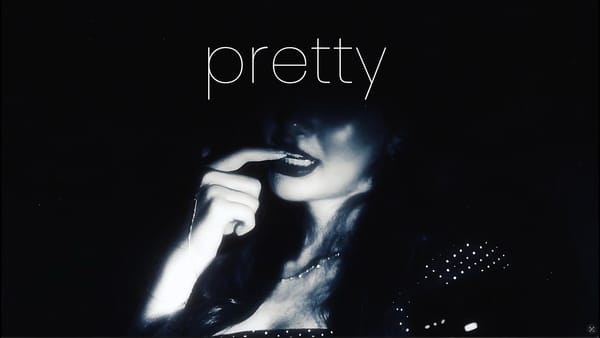
I wrote my first feature-length script when I was nineteen, so I know what it takes to finish one. Metecan Duren, a nineteen-year-old medical student in Istanbul, wrote Pretty, and then went out with his classmates and shot the whole thing, edited it, and composed the score between lectures. I have to respect that kind of stubbornness.
Dear reader, please consider becoming a paid subscriber today. The work we do at the Unenlightened Generalists is supported directly by you, our readers. Every week, we spend dozens of hours planning, researching, and writing material from YouTube videos to these very articles. This work is our joy and passion, but it's you that makes it possible.
In Pretty, Melisa Kihtir plays a young woman (actually named Pretty) living with her older sister Emma (Saran Duren) in a large, quiet house while their parents are supposedly away in Moscow. On a walk home with a neighbor, Tom (Omer Gursoy), Pretty hears a voice calling from nearby and finds a girl named Betty (Alina Zakharova) speaking from behind the door of an abandoned cabin. Things only escalate from there. Soon enough, Pretty is trading late-night messages with an online stranger under the handle obey.the1, her cousins Ivy and Lea are coming to stay for the holiday break, and someone in a strange mask is stalking her from the shadows.
If you want a clean plot summary during the first hour, good luck. It's hard to get an immediate sense of what the film is doing, and the narrative wanders down hallways that don't always connect. Yet the sheer weirdness of the thing exerts a pull that pulls at you and keeps you in your chair.
The main reason the film holds is the soundscape. Duren builds the horror out of his own electronic score, a low nondiegetic hum, and small, sharp household sounds: the rasp of curtains on a rod and the steady tick of a clock in an empty room. The house has an embodied atmosphere that gets under your skin. Even when a scene is dragging on screen, the audio track keeps your shoulders up around your ears.
The camera work is the other major strength. There are plenty of little gaps and hiccups you expect from a micro-budget student film—a camera light flaring in a character's glasses, a few interiors that swallow the actors in murk—and yes, at times the seams showed. That's expected when you've got young performers, basic gear, and you're trying to create a feature film around a full-time medical student's course schedule. But ultimately, Duren pulls off controlled sequences, pairing off-kilter angles and patient long takes with sudden, fast cuts, so the tension can tighten slowly or snap shut. A green-lit shot at a mirror and an early, held frame on the house's staircase do more with a couple of lights and an open doorway than plenty of studio horror manages with millions.
He even makes the texting scenes work. Epistolary stretches where characters stare at their phones and type back and forth are notoriously dead air on screen, and Pretty spends a lot of time on them. And yet they're engrossing. Part of it is how tight Duren shoots the screen, and part of it is the rhythm of the typing itself. Pretty is staring at her phone. On the other end, a stranger claims he can "feel" her through the text, while the actual house around her grows more dangerous by the hour. It's Plato's cave with a phone screen: a narrow window mistaken for the whole world. The smaller Pretty's field of view gets, the easier she is to lure down into the dark.
I should also admit that parts of the movie are flat-out ridiculous. At one point, Tom and the girls see a masked figure sprinting toward the house, and then all of them casually turn their backs on the giant glass door they just watched him run toward. And all of these young women go to bed in full daytime outfits, complete with makeup and jewelry. The film never explains. But I'd also argue that it doesn't really need to... because the outfits are part of the dream.
Those choices would sink a more conventional thriller. Here, they mostly fold into the film's strange, stagy atmosphere. This whole film actually reminds me of the term coined by Mark Fisher, the British cultural critic: hauntology. The crackle on an old record that refuses to let us fall into the comfortable illusion of presence. The sound of time out of joint. Pretty is full of that kind of crackle. The dead cell service, the girl speaking from "the space between" behind a wooden door, the scenes that refuse to line up in neat chronological order... it all moves like a nightmare. When you're dreaming, you don't ask why your shoes are still on in bed, or why the phone won't dial the police. You just know something is coming up the stairs and so you run.
Spoilers ahead for the final act.
When the explanation finally arrives in the last half-hour, the film splits in two, and one half works much better than the other.
On the mythic side, we get a piece of folklore about a white rabbit skinned alive by a vain nobleman for a cloak; the ruined creature survives by bargaining with something older than the gods, rising as a dark star that grants beauty, attention, and worship in exchange for the blood of the petitioner's kin. We learn that Pretty's parents made that bargain so their daughter could "float above" humanity, and then tried to cheat the bill. It's a folk-horror fable about vanity and the hunger to be looked at, even if the late-stage exposition lays the lore on thick.
What hits hard, though, is the domestic reveal underneath it. In a long confrontation at the table, Emma finally breaks and tells Pretty that their parents aren't in Moscow. They killed themselves four years ago. Pretty blacked out from the shock, and the doctors told a fifteen-year-old Emma to play along with her sister's delusion so her mind wouldn't shatter.
Saran Duren is terrific in this stretch. All of Emma's earlier cruelty ("No one will ever want you, Pretty") suddenly reads as the exhaustion of a kid who had to keep her parents' deaths secret and spend four years tending to a sister who dressed up in fur coats and red lipstick while the family fell apart around her. They're two damaged sisters locked in the same lie from opposite sides, and the film lets both of them be right and wrong at once. That human messiness is just as unsettling as the demon in the rabbit mask, and the film briefly dredges up a sense of aching tragedy in it before it drifts back into a drawn-out, trance-like finale.
Does Pretty hold together as a clean two-hour story? Not really. The script repeats itself, some of the supporting performances are stiff, and the ending lingers after the point has landed.
I'm still glad I watched it. I'll take a ragged film that knows how to make a hallway feel haunted over a polished one with nothing on its mind. Duren already knows how to use a camera and a microphone to get under your skin. Once his script writing catches up to his ear, watch out, we'll have a new auteur in town.
Pretty (2026) is available to stream for free on YouTube. Runtime: 123 minutes. Written, directed, shot, edited, and scored by Metecan Duren. Starring Melisa Kihtir, Saran Duren, Omer Gursoy, Iclal Aykac, Kayra Dogan, Efe Kaspi, Alina Zakharova, Ferhad Gurbanov, and Ayşin Şahin.
I’m Odin Halvorson, a librarian, life coach, and fiction author. If you like my work and want to support what we do here at Unenlightened Generalists, please consider becoming a paid subscriber to our newsletter for as little as $2.50 a month!
Support us in other ways:
- Start writing and reading with the Supernote, and support me at the same time!
- Like audiobooks? Hate DRM? Use this affiliate link to sign up for Libro.fm, where you actually own the books you buy!
- Want your own Ghost newsletter? Check out MagicPages for the cheapest hosting rates via my affiliate link (they even offer lifetime hosting plans!)
Thanks for your support!