Every so often a tabletop podcast comes along that makes you pause mid-episode and think, wait — how are they doing this?
That's been my experience with Who's on First Watch?, a Daggerheart actual play set in the dying homebrew world of Hammanaroth. It's dark fantasy in the truest sense — a band of broken heroes facing up against war, magic, and cosmic horror, and it runs on the Daggerheart system, created by Critical Role and published by Darrington Press. And the fascinating thing is that its quality appears to come much more from table design and cast discipline than from professional acting credentials or extravagant equipment.
There isn't yet a comprehensive behind-the-scenes breakdown of the show, so let me be clear about what's confirmed and what I'm inferring from the finished episodes. The confirmed details come from their official cast and production page and a short profile of Rich and the show.
The table behind the curtain
Two mates, bound by TTRPGs since 2004, built Hammanaroth together — a homebrew world full of pop-culture nods, big set pieces, and plenty of room for heartfelt storytelling. After a few false starts and practice runs, the right cast came together, and the podcast was born.
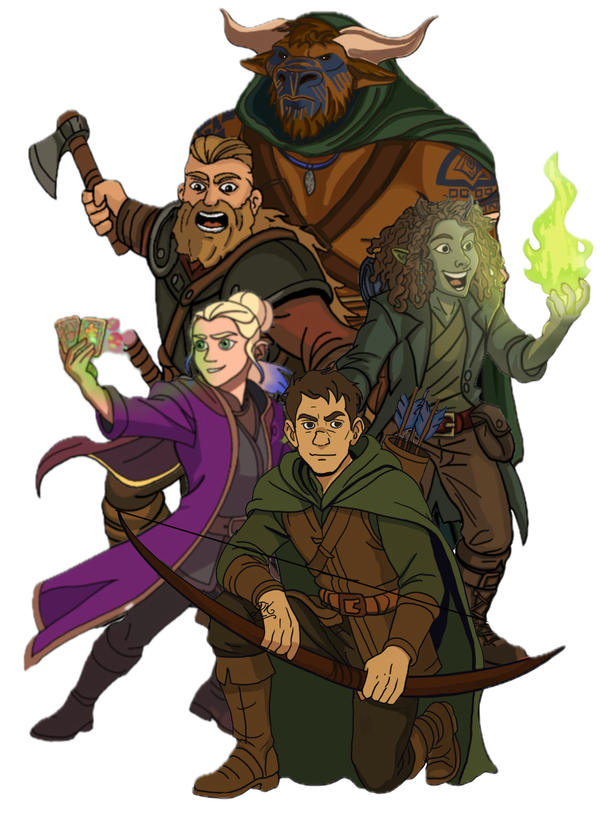
And what a cast it is. One might be forgiven for assuming that the show is actually a room full of ringers quietly moonlighting as an acting troupe, but no — it's a group of genuine hobbyists who simply love what they do:
- Rich (the DM, co-creator and producer) cut his teeth on Tunnels & Trolls and Dragon Warrior before D&D, and the site lovingly describes him as a "master of lore, imposter syndrome, and emergency improvisation." That last phrase tells you everything.
- Sean (Tholandi Vurthr) is an old-school player who still remembers THAC0 and Monster Manual binders, and now runs games for his kids.
- Sarah (Faedra) is a 90s kid raised on Tolkien and Pratchett who, tellingly, "loves voices, characters, and both sides of the DM screen."
- Nathan (Bjorn Erickson) is white-collar by day, a nerd since 1987, and a man who has flown an actual Spitfire.
- Liv (Kaia Vaelros) is an Allied Health Professional by day and an aspiring voice actor by night, a self-confessed dice goblin stepping into the spotlight.
- Harry (Kremlev Pavlenko) is a lifelong hobbyist and DM-turned-player, happiest pushing miniatures or rolling dice with friends.
The result is something rare: a table where everyone listens to one-antoher and commits to their roles. I've played a lot of games over the years and it's still hella rare that I encounter a table that can actually protect the fiction in such a way. Therein lies magic.
Prepared, not scripted
Here's the most important distinction the show gets right: prepared versus scripted.
Rich prepares a world that already feels like it exists beyond the player characters. NPCs with strong desires and recognizable voices. Situations that cannot remain stable. Threats and revelations tied to specific characters. Large visual or emotional set pieces. Enough hidden information to reward investigation — but all (apparently) without ever prescribing how it unfolds.
He just lets Daggerheart itself, and the players, decide when and how everything collides.
That's why the campaign sounds "written" without ever sounding railroaded. Events have thematic coherence, but the conversations still contain genuine discovery. I think it might be easy for a GM to just improvise random complications every time Fear shows up, but Rich seems to have a reservoir of meaningful pressures ready to introduce, when the dice say it's time for one to arrive.
The cast's real craft
The players are doing several things that many actual-play casts (even some very good ones) don't consistently do:
- They speak to one another, not merely to the GM.
- They treat each other's choices as interesting dramatic offers.
- They stay inside their characters' emotional perspectives.
- They let tension and disagreement stand without immediately defusing it with a joke.
- They ask questions whose answers could genuinely alter their relationships.
- They make imperfect decisions, because those decisions make sense for the character.
- They don't all fight for equal airtime in every scene.
- Their voices are recognizable without becoming exhausting caricatures.
That is acting, even if most of them aren't professional actors. It's mostly listening, commitment, emotional continuity, and restraint.
The editing is top-notch
The episodes land around 30–60 minutes and begin in the middle of an active situation, ending on a meaningful turn. Longer sessions are clearly being trimmed around narrative movements: but it's done so deftly that you'd hardly ever know.
The score from Fantasy+ — a library of licensed cinematic music, ambience, and effects — makes already solid scenes feel cinematic in a really powerful way. But, as I learned when doing film school, effects and music too frequently hide a myriad of sins. It's easy to reach for a thematic music track and let the score carry the dead weight of a lackluster scene (as many actual play podcasts have done). But when the table is supplying good raw material first? That's when the addition of score and effects turns the whole thing into a polished spectacle. And what's more, it's all done in Audacity, self-funded, and with friends at Heart of Daggers in their corner. As a mega fan of open source-produced work, this is a cherry on top for me.
Advice Time: What I'd steal for your own Daggerheart table
You don't need their exact production. I'd say that the key thing would be to reproduce their play culture:
- Build characters together and deliberately intertwine their histories.
- Give every character something they want, something they conceal, and something another PC can challenge.
- Establish that emotional scenes won't be punctured by out-of-character humor.
- Ask players to address one another in character before asking the GM what happens.
- Use Fear to intensify an existing problem or shore up the larger plot — not to introduce unrelated random trouble.
- Prepare NPC objectives and impending events rather than scripted outcomes.
- Begin scenes when something is already happening.
- End or transition once the scene delivers its decision, discovery, or emotional change.
- Let quiet characters own their scenes without everyone forcing themselves in.
- Treat character voices as optional; character perspective is mandatory.
The genuinely encouraging conclusion here is that the show's secret does not appear to be "hire five voice actors and buy ten grand of gear." Instead, it's a product of decades of GM experience, a well-developed world, and a great group of friends who love doing character work (and who are willing to perform sincerely).
Who's on First Watch? is the proof that an ordinary table — your table — can sound extraordinary if you prepare like a storyteller and listen to your fellow players like a true actor.
Go subscribe. Thank me later.
You can also find out more about them on TikTok.
Subscribe to Unenlightened Generalists